

Naturehike hiking gear has gone from an AliExpress curiosity to a brand you can order through Mountain Warehouse, where the Cloud Up 2 sells for £129.99 and the Cloud Creek 2 for £94.99. That is roughly a third of what many hikers pay for a premium ultralight shelter of similar weight. A price gap that wide makes people suspicious, and they are right to ask questions before trusting a tent with a night on an exposed fell.
This guide answers those questions plainly. It covers who Naturehike actually is, where the gear is made, why it costs so little, which Naturehike tents are worth buying and how they cope with the wind and rain that define hiking in Britain. You will also find a straight comparison with Blackdog, the brand people keep confusing it with.
The goal is simple: by the end, you should know whether a Naturehike 2 person hiking tent fits your trips, which model to pick and what to change on it before your first wild camp.
Why Naturehike Hiking Gear Splits Opinion
Search for reviews and you will find two camps. One group of hikers has carried the same Naturehike tent for five years and calls it the best value in backpacking. The other group points to a weak Trustpilot score for the brand’s own web store, a bent peg, a missing guy line or a floor that wore through on gravel.
Both groups are describing the same company. The difference usually comes down to which model they bought, where they bought it and what they expected from it. A budget tent bought from a marketplace seller with slow support feels very different from the same tent bought from a retailer with a 60-day returns policy.
The real job behind the search
Most people researching Naturehike hiking gear are not looking for a cheap tent for the sake of it. They want to start backpacking, or replace a heavy old tent, without spending £400 to £600 on a shelter they might use six nights a year.
That is a reasonable goal. A first 2 person tent should be light enough to carry, simple to pitch in the rain and tough enough to last several seasons. The question is whether Naturehike meets that bar, and where the compromises sit.
What this guide covers
You will get a clear answer on each of the questions hikers ask most:
- Whether Naturehike is a legitimate brand and who owns it
- Where Naturehike products are made and why they cost so little
- Which Naturehike tents perform best for hiking, with specs side by side
- How Blackdog relates to Naturehike and which suits you better
- What the best tent for hiking in the UK needs to handle
- The common mistakes that make a good budget tent feel bad
Each section stands on its own, so jump to the part you need using the table of contents.
Is Naturehike a Legit Brand? Who Makes Naturehike Hiking Gear
Yes, Naturehike is a legitimate, registered outdoor brand, not a white-label name stuck on generic gear. That distinction matters, because the budget tent market is full of near-identical products sold under dozens of short-lived names.
According to the company’s own brand statement, Naturehike is a registered trademark owned by Hongkong Naturehike International Limited. A wholly owned subsidiary based in Ningbo handles international trade, sales and the running of the brand worldwide. Retailers and distributors in Europe, Asia and Australia stock it under that one name.
Where the brand comes from
Naturehike’s own story says it was founded in 2010 by a founder and CEO who describes himself as a keen traveler, with the goal of making affordable, quality gear. Mountain Warehouse repeats that date and says the brand now sells in more than 60 countries.
Some business databases list an earlier start. CB Insights, for example, records a founding year of 2005 and reports outside investment from Eastern Bell Capital, a venture firm. The likely explanation is that the business existed in some form before the brand went international. Either way, this is a company with well over a decade of trading behind it.
Where are Naturehike products made?
Naturehike products are made in China. The brand designs its gear in-house and works with Chinese manufacturing, which is also where most outdoor brands, including many premium Western names, produce their tents.
“Made in China” is not a quality verdict on its own. Factories in China make some of the most expensive tents on the market. What separates brands is the specification they order, the quality control they pay for and how they handle the faults that slip through.
Naturehike’s strength is that it designs and sells its own models rather than copying logos. Its weakness, which we cover below, is that quality control can vary between batches and between versions of the same tent.
What the reviews actually say
Long-term owner reviews are more useful than star ratings here. One reviewer on the Mom Goes Camping blog, writing after five years with a Cloud Up 2, praised Naturehike for honest weight claims and consistent build quality. That review also flagged real compromises: droopy side walls and a sleeping position with your head toward the door.
Clever Hiker included the Cloud Up 2 in its budget tent guide and liked the 20D silicone-coated ripstop nylon fly and the reinforced corners. The same testers found that their head and toes touched the walls on an air mat, with only a few inches spare at each end.
On UK forums such as Walkhighlands, the conversation is practical rather than hostile. Hikers compare the Mongar 2 and Star River 2 on doors, weight and wind performance. Naturehike tents are treated as a sensible budget option, not a gamble.
The poor scores tend to cluster around one thing: ordering from the brand’s own international web store, where shipping times and support can disappoint. That is a buying-channel problem more than a tent problem.
Why Is Naturehike So Cheap?
Naturehike is cheap mainly because it sells close to direct and skips much of the cost that a Western outdoor brand builds into its price. That includes large retail networks, sponsored athletes, glossy marketing campaigns, local repair centers and lifetime warranties.
When you buy a premium tent, a large share of the price pays for that ecosystem. When you buy from Naturehike, you pay mostly for the materials and the manufacturing, plus a thinner margin.
Where the savings come from
The savings stack up in a few predictable places:
- Scale. Naturehike sells huge volumes across Asia and online, which lowers the cost of every tent it makes.
- Shared parts. Many models use the same poles, fabrics and hub designs, which cuts development and tooling costs.
- Lean distribution. Much of the range sells through online marketplaces rather than through high-street shops with rent and staff.
- Familiar designs. Several Naturehike tents follow proven layouts. The Mongar 2, for instance, is widely compared to the MSR Hubba Hubba because it uses a similar freestanding, two-door design.
None of those savings require poor materials. The Cloud Up 2 and Star River 2 both use 20D nylon on their flysheets, and the Mongar 2 uses 7001 aluminum poles, which are common choices on far more expensive tents.
What you give up for the lower price
Cheaper does come with trade-offs, and it is better to know them before you buy:
- Stakes and guy lines. Owners often report thin, easily bent stakes and basic cord. Many replace both straight away.
- Quality control. Batch-to-batch variation is higher than with premium brands, so a small number of units arrive with faults.
- Warranty and support. Naturehike lists a limited warranty, but claims can be slower than with a brand that has a UK service center.
- Version confusion. The same model name often covers several versions with different fabrics and weights, which makes comparing specs harder.
In practice, the fixes are cheap. A set of better stakes costs less than £20 and turns a wobbly pitch into a solid one. Buying from a UK retailer with an easy returns window takes care of most quality-control worries.
Is cheap the same as low quality?
No. A Naturehike tent costs less mainly because you are not paying for a brand story or a service network. You are still getting coated nylon, aluminum poles and taped seams on the better models.
Where cheap and low quality do overlap is at the very bottom of the range. The heavier, polyester campsite tents are built to a price, and they are not the models to carry up a mountain. For hiking, stick with the lightweight backpacking series.
Are Naturehike Tents Any Good? Strengths and Weak Spots
For most three-season hiking, yes, Naturehike tents are good, and the best models are very good for their price. They are not as refined, roomy or storm-proof as top-tier shelters, but they get closer than the price suggests.
The easiest way to judge them is to look at where they consistently shine and where they consistently fall short.
Where Naturehike tents shine
Weight for money is the headline strength. Reviewers report the Cloud Up 2 at around 1.7 kg for the tent alone, or roughly 1.9 kg with poles, stakes and lines. A Naturehike 2 person tent in that range is light enough for multi-day trips without an ultralight price.
Pitching is another strong point. The Cloud Up 2 uses a single hubbed pole with a Y-shaped end, so it goes up in minutes. The Mongar 2 uses a simple freestanding frame that one person can pitch in under ten minutes, according to a Mad or Nomad review that called it a very good tent for the money.
Flexibility helps too. Many Naturehike tents can be pitched fly-first in the rain, so the inner stays dry, and the Mongar can be pitched inner-only on warm, dry nights.
Where they fall short
Space is the most common complaint. Naturehike rates its tents generously, so a 2 person tent from the brand often feels like a roomy one-person tent with space for gear. Several Cloud Up 2 owners describe it as a “1.5 person” tent.
Wind handling depends heavily on the model and the pitch. Single-hub designs such as the Cloud Up 2 do best with the low end pointed into the wind. Owners of the Cloud Up range repeatedly stress that position matters.
Cold-weather comfort is limited. A Packstack review of the Mongar 2 noted that its airy mesh inner holds little warmth, so inside temperatures sit close to outside on freezing nights.
Who should buy one
A Naturehike tent suits you if you hike mostly from spring to autumn, camp a handful of nights a year, value low weight and want to spend under £170. It also suits beginners who are not yet sure how much backpacking they will do.
It suits you less if you regularly camp above the tree line in winter, need a tent for two broad-shouldered adults with full kit inside, or want a lifetime warranty and a local repair service. In those cases, saving up for a premium mountain tent makes more sense.
The 7 Best Naturehike Tents for Hiking
The range is large and confusing, so this shortlist focuses on the Naturehike tents that make the most sense for hiking. Specs vary between versions and colorways, so treat the weights below as typical figures and always check the listing for the exact version you are buying.
| Tent | Sleeps (realistic) | Typical weight | Doors | Best for |
|---|---|---|---|---|
| Cloud Up 2 | 1 plus gear, or 2 snug | About 1.7–1.9 kg | 1 | Light solo or tight duo trips |
| Mongar 2 | 2 | About 1.8–2.1 kg | 2 | Couples and friends |
| Star River 2 UL | 2 | About 1.4 kg tent only, 1.85 kg packed | 2 | Lighter two-door option |
| Cloud Up 3 | 2 comfortably | About 2.2 kg packed | 1 | Two adults who want room |
| Star River EXT 2 | 2 | About 1.35 kg without groundsheet | 2 | Exposed, windy pitches |
| Cloud Creek 2 | 2 | Check listing | Check listing | Budget campsite and easy trails |
| Cloud Up 1 | 1 | About 1.5 kg | 1 | Solo hikers on a budget |
1. Cloud Up 2: the model that made the brand
The Cloud Up 2 is the classic Naturehike hiking tent. It is light, packs small and goes up quickly thanks to its single-pole hub. Mountain Warehouse lists it at £129.99, and it often appears for less on sale.
The catch is space. It is a narrow 2 person tent with sloping walls and a single door at the head end. For solo hikers who want room for kit, it is excellent. For two adults, it is snug.
2. Mongar 2: the best all-round 2 person hiking tent
The Mongar 2 is the pick for most couples. It has two doors and two vestibules, so nobody climbs over anyone to get out at night, and its steeper walls give real sitting room. It uses 20D nylon and 7001 aluminum poles.
Reviewers put the full kit at around 2 kg, which is reasonable when split between two hikers. Mad or Nomad paid about £165 for theirs and reported no leaks through the fly in rain. The stakes are weak, so upgrade them.
3. Star River 2 UL: the lighter two-door choice
The Star River 2 offers a two-door, two-vestibule layout in a lighter package. Retail listings for the UL version quote an inner of 210 by 130 by 105 cm and about 1.44 kg without accessories.
Unlike the symmetrical Mongar, the Star River has a defined head and foot. UK forum users describe its inner doors as rainbow zips that drop down, versus the Mongar’s D-shaped doors. Both work well; the Star River saves a little weight.
4. Cloud Up 3: a 2 person tent that actually fits two
If two adults want to share a Cloud Up without touching walls all night, buy the 3-person version. Long-term reviewers call it the “Goldilocks” option for couples because it adds width and a crossbar for headroom.
The weight penalty is modest. One five-year owner weighed the full Cloud Up 3 kit at about 4.85 lbs, or roughly 2.2 kg, compared with about 1.8 kg for the Cloud Up 2 kit.
5. Star River EXT 2: for exposed pitches
Naturehike markets the Star River EXT 2 as a stable shelter designed for harsh weather, at a claimed 2.98 lbs, about 1.35 kg, without its groundsheet. That makes it one of the more interesting Naturehike tents for upland Britain.
It is newer and has far fewer long-term reviews than the Cloud Up or Mongar. Treat the weather claims with healthy caution until more real-world reports appear, and test your pitch in your garden first.
6. Cloud Creek 2: the budget campsite option
The Cloud Creek 2 sits at the cheaper end of the range and sells through Mountain Warehouse’s marketplace for £94.99. It is best viewed as a tent for valley campsites, festivals and gentle trails rather than long mountain days.
Check the listed weight, fabric and waterproof rating carefully before buying it for backpacking. The lightweight Cloud Up and Star River series are the better choices for serious Naturehike hiking trips.
7. Cloud Up 1: the solo saver
For solo hikers, the Cloud Up 1 delivers most of the Cloud Up 2’s benefits at a lower weight. Retail comparisons put it at about 1.5 kg and around $130, a similar price to many budget one-person tents that weigh far more.
Many solo hikers still choose the Cloud Up 2 instead, because the extra width for gear costs only a little more weight. If you value elbow room, do the same.
Which Naturehike Tent Is the Best? Matching the 2 Person Hiking Tent to Your Trip
There is no single best Naturehike tent, because the best choice depends on who sleeps in it and where. The quickest way to choose is to match the tent to your most common trip, not your most ambitious one.
For solo hikers
Pick the Cloud Up 2. It gives a solo hiker space for a pack, boots and wet layers inside, while keeping weight low. Point the foot end into the wind and pitch it fly-first when it rains.
For couples and friends
Pick the Mongar 2 or Star River 2. Two doors and two vestibules make a bigger difference to comfort than a few hundred grams. If you share the load, each person carries about 1 kg.
If you both prefer a single-door tent with more floor width, choose the Cloud Up 3. It is the most comfortable 2 person hiking tent in the Cloud Up family.
For windy uplands
Look at the Star River EXT 2 or a well-pitched Mongar 2 with upgraded stakes and extra guy lines. Avoid tall, flat-sided tents on exposed ground, and always check the forecast for gusts rather than average wind speed.
For tight budgets and campsites
The Cloud Creek 2 works for car-based campsite weekends and short walks. Pair it with a sensible arrival plan; our guide to car hiking and the best cars for trail access covers getting to trailheads with your kit.
Blackdog vs Naturehike: Which Is Better?
Blackdog and Naturehike are not true rivals. Blackdog is a sub-brand of Naturehike, so the real question is which product line suits your style of camping.
Market reports and retailers describe the split clearly. Naturehike covers professional lightweight and ultralight gear, including the Cloud Up and P-Series tents. Blackdog covers camping lifestyle and glamping, with a matte black look and larger, more comfortable shelters.
When Naturehike is better
Choose Naturehike if you carry your tent on your back. Its backpacking range focuses on low weight, small pack size and quick pitching, which is what a hiker needs.
The black Blackdog shelters look striking, but black fabric absorbs heat in sunshine, and many of the larger designs use heavier poles and fabrics. That is fine next to a car and a poor trade on a 20 km hiking day.
When Blackdog is better
Choose Blackdog if you camp beside the car and want comfort, style and space. Its pyramid and cabin-style tents suit base camps, family weekends and glamping setups where weight hardly matters.
Some buyers also like the darker interiors for sleeping past sunrise in summer, when British dawns come very early.
The short verdict
For hiking, Naturehike is better. For lifestyle camping, Blackdog is better. Because both come from the same parent company, build quality and support tend to be similar, so choose on purpose rather than brand.
Best Tent for Hiking in the UK: What a 2 Person Tent Must Handle
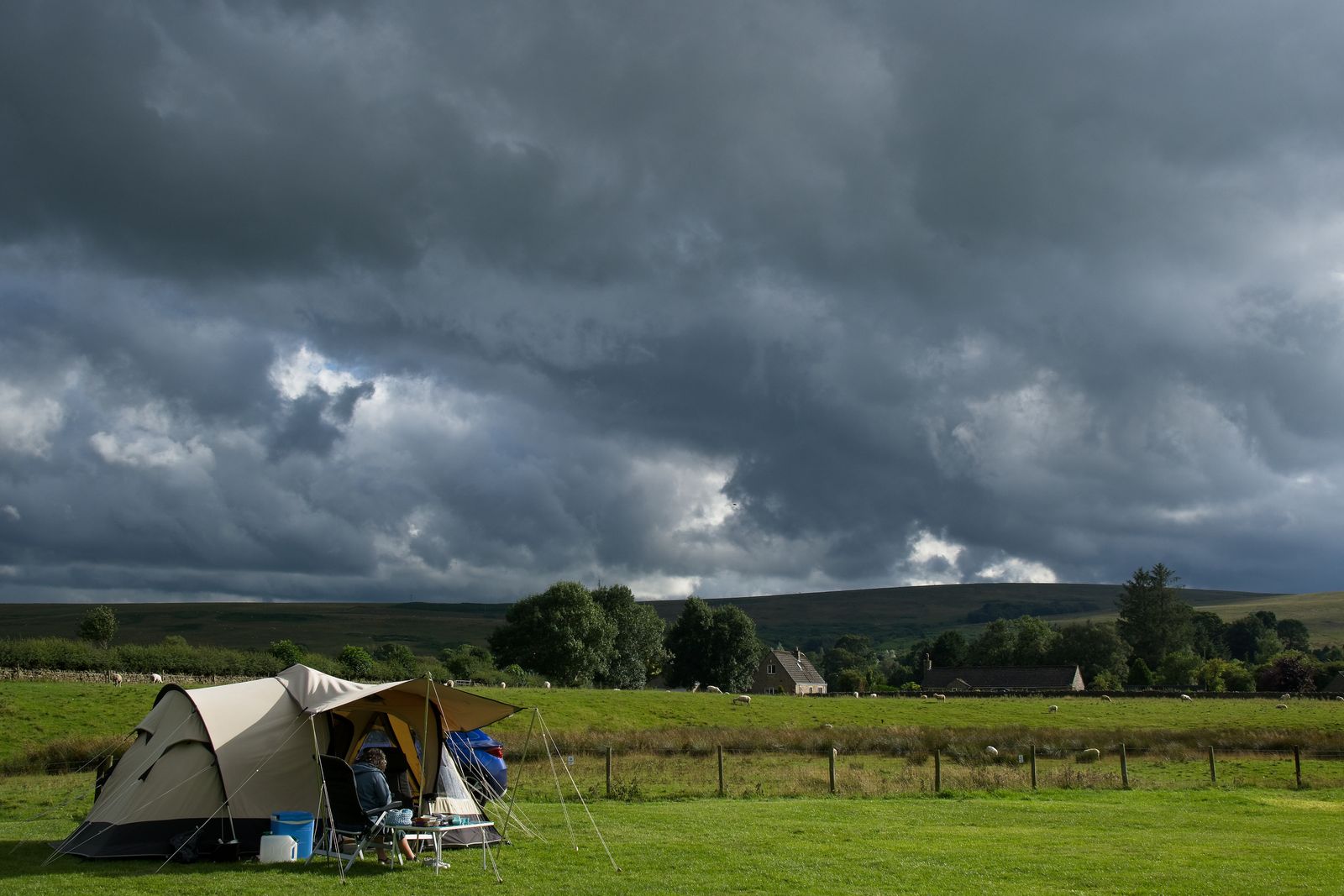
The best tent for hiking in the UK is one that sheds rain, handles gusty wind, manages condensation and pitches quickly in bad weather. Floor space and weight matter, but British weather decides whether a night is good or miserable.
You do not need a four-season expedition tent for most UK trips. You do need a three-season tent with a decent waterproof rating, a stable shape and enough guying points to lock it down.
Rain and waterproof ratings
Waterproofing is measured as hydrostatic head, in millimeters. Most quality hiking flysheets sit between about 1,500 mm and 3,000 mm. Many Naturehike flysheets are rated at around 3,000 mm, and the Mongar 2 is often listed at 4,000 mm.
Seams matter as much as fabric. Naturehike states that the seams on its waterproof tents are taped. Even so, applying a little seam sealer to stress points before your first trip is cheap insurance.
Wind and pitching
Wind is the bigger test on British hills. A low, aerodynamic tent pitched with the narrow end into the wind will outlast a taller one pitched side-on. Use every guy line, and carry a few spare stakes for soft or rocky ground.
Fly-first pitching is a real advantage in a downpour. The Cloud Up 2 and Star River designs allow it, so your inner tent stays dry while you set up.
Condensation in damp air
British nights are often humid and still, which means condensation. Keep vents open, pitch away from hollows where cold air collects, and avoid cooking inside the porch with the doors shut. A small towel to wipe the inner is worth its weight.
Where you can wild camp
Rules differ across the UK. In Scotland, responsible wild camping is allowed on most unenclosed land under the Scottish Outdoor Access Code. In England and Wales, you generally need the landowner’s permission.
The big exception is Dartmoor, where the Supreme Court unanimously upheld the right to backpack camp on the Dartmoor Commons, as the British Mountaineering Council explains in its summary of the ruling. Check the Dartmoor National Park Authority’s camping map before you go.
Night hiking and late arrivals
Short winter days mean many UK hikers pitch in the dark. A bright, comfortable headlamp turns a fiddly pitch into a quick one; see our guide to the best hiking headlamp for night hikes for picks with a red light mode that will not wake your tent partner.
Naturehike Hiking Mistakes to Avoid
Most bad experiences with Naturehike hiking gear come from a handful of avoidable mistakes. Fix these and a budget tent performs far closer to a premium one.
Trusting the sleeping capacity
Do not assume a Naturehike 2 person tent comfortably fits two large adults and their packs. Check the floor width, and if two of you are over six feet or like space, size up to a three-person model.
Keeping the stock stakes
The supplied stakes are the weakest link on many Naturehike tents. Swap them for stronger Y-section or V-section aluminum stakes, and add one or two longer stakes for soft peat or sandy ground.
Skipping a test pitch
Pitch your tent at home before the trip. Learn which clips go where, practice fly-first pitching and check every seam and zip. It is far easier to return a faulty tent from your garden than from a hillside.
Buying the wrong version
Model names hide different versions. A Cloud Up 2 in 20D nylon is not the same as an older 210T polyester version. Read the fabric, weight and waterproof rating on the exact listing, not just the model name.
Packing it away wet
Never store a tent wet. Naturehike’s own care notes say the same: dry it fully at home, ideally pitched, before storing it loosely. Mildew destroys coatings faster than years of use.
Ignoring the rest of your kit
A good tent cannot fix a cold sleeping system or poor clothing. A warm mat, a sleeping bag rated for the season and a sun layer for open moorland all matter. Our guide to the best hiking hoodie for sun protection covers the layer many hikers forget, and our wooden hiking sticks guide explains how a stick can double as a tent pole on some shelters.
Naturehike Hiking Kit Beyond the Tent
Tents get most of the attention, but Naturehike hiking gear covers almost everything you need for a night outside. Mountain Warehouse alone lists dozens of Naturehike items, from sleeping bags to cook sets, and the same pricing logic applies: solid basics for far less than premium brands charge.
The trick is knowing which pieces earn their place in a hiking pack and which belong in the car.
Sleeping bags
The U Series hooded sleeping bags are the most useful pick for hikers on a budget. Mountain Warehouse lists the U150 at £29.99, the U250 at £45.99 and the U350 at £55.99, with the number roughly signaling the fill and warmth.
For UK summer trips, a lighter bag paired with a liner works well. For spring and autumn on the hills, choose a warmer model and check the comfort rating rather than the extreme rating. A cold night in a good 2 person tent is still a cold night.
Sleeping mats
A mat matters as much as a sleeping bag, because the ground steals heat all night. The Tuye 4.6 ultralight inflatable mattress sells for £79.99 and packs small enough for a backpack.
Look for the mat’s insulation rating if one is listed. A thicker mat also helps in narrow tents such as the Cloud Up 2, where comfort depends on not feeling every stone through the floor.
Cooking and camp comfort
The Wild Trekking aluminum cook set costs £34.99 and covers basic boil-and-eat meals for one or two people. Pair it with a small gas stove and a windshield for exposed pitches.
Camp chairs and folding tables, such as the Ultralight Moon Camping Chair at £44.99, are lovely at a campsite but usually too heavy for multi-day routes. Leave them for car-based weekends.
Building a budget kit that works
A sensible Naturehike hiking setup for one person might combine a Cloud Up 2, a U250 sleeping bag, an inflatable mat and the cook set. Bought together, that core kit costs far less than a single premium ultralight tent.
For two people, swap the Cloud Up 2 for a Mongar 2 and add a second bag and mat. Splitting the tent between packs keeps each person’s load reasonable, and you still have budget left for better stakes and a decent headlamp.
How to Buy Naturehike Tents in the UK Safely
Where you buy affects your experience as much as which model you pick. The same tent can feel like a bargain or a headache depending on the seller.
Choose a seller with easy returns
UK retailers such as Mountain Warehouse list a range of Naturehike tents through marketplace partners, and the retailer advertises 60-day returns. Large online marketplaces also offer simple returns. Both are safer than waiting weeks for an international parcel.
Check the exact listing details
Before you buy, confirm these details on the product page:
- The fabric denier and type, such as 20D silicone nylon
- The hydrostatic head rating of the fly and the floor
- The packed weight and what it includes
- Whether a footprint or groundsheet comes in the box
- The pole material, ideally aluminum alloy rather than fiberglass
Budget for the small upgrades
Set aside £20 to £30 for better stakes, a little extra guy line and seam sealer. Those small extras transform a Naturehike tent on a windy, wet night and cost far less than the gap to a premium shelter.
Know when to spend more
If you plan regular winter camping, long-distance routes with nightly rain or trips with a partner who needs lots of space, a premium mountain tent may be worth the money. Naturehike tents are a smart start, and many hikers keep theirs as a backup after upgrading.
Naturehike Hiking FAQ
Is NatureHike a legit brand?
Yes. Naturehike is a registered brand owned by Hongkong Naturehike International Limited, with a Ningbo subsidiary that runs global sales. It has traded for well over a decade and is stocked by mainstream retailers such as Mountain Warehouse.
Why is NatureHike so cheap?
Naturehike sells close to direct and avoids much of the retail, marketing and warranty cost built into Western outdoor brands. Large production volumes and shared parts across models lower costs further. The trade-offs are basic stakes, more variable quality control and slower support.
Where are NatureHike products made?
Naturehike products are designed by the brand and made in China. That is also where many premium outdoor brands manufacture their tents, so the country of origin says less about quality than the specification and quality control do.
Which NatureHike tent is the best?
For most hikers, the Mongar 2 is the best all-round 2 person hiking tent thanks to its two doors and roomy walls. Solo hikers often prefer the lighter Cloud Up 2, and couples who want more space should look at the Cloud Up 3.
Which is better, Blackdog or Naturehike?
Blackdog is Naturehike’s sub-brand for lifestyle and glamping gear. For hiking, Naturehike is better because its tents are lighter and pack smaller. For car camping and style-led base camps, Blackdog is the better fit.
Are Naturehike tents any good?
Yes, for three-season hiking they offer excellent value. Naturehike tents are light, quick to pitch and well made for the price. Expect tighter interiors than the name suggests and plan to upgrade the stakes.
What is the best tent for hiking in the UK?
The best tent for hiking in the UK is a stable three-season 2 person tent with a fly rated around 3,000 mm, taped seams, plenty of guy points and fly-first pitching. On a budget, a well-pitched Mongar 2 or Cloud Up 2 does the job for most trips.
Can a Naturehike 2 person tent handle Scottish weather?
A Naturehike 2 person tent can handle typical three-season Scottish weather if you pitch it low, face the narrow end into the wind and use strong stakes. For winter storms on high, exposed ground, choose a dedicated mountain tent instead.
Final Verdict on Naturehike Hiking Tents
Naturehike is a real brand that makes genuinely useful hiking tents at prices that remove the biggest barrier to backpacking. It is cheap because it skips the costs of a Western brand ecosystem, not because it uses junk materials, although quality control and support are less polished.
For most UK hikers, the smartest Naturehike hiking setup is a Mongar 2 for two people or a Cloud Up 2 for one, bought from a seller with easy returns, fitted with better stakes and test-pitched at home first. Do that, and a sub-£170 tent can carry you through years of spring-to-autumn trips.
Your next step is simple: decide who will sleep in the tent, pick the matching model from the table above and order it early enough to practice a fly-first pitch before your first wild camp. While you are kitting out, our guide to the best hiking hats for sun protection helps with the rest of your trail setup.
The outdoors does not need to cost a fortune. With the right budget tent and a few smart upgrades, the only thing left to plan is the route.